

We Tokenized the World. We Forgot to Ask Who Gets In.
And quietly, the machines started managing the answer.

Here’s a number that should stop you cold.
The tokenized real-world asset market hit $29 billion this month. US Treasuries alone, government bonds, now living on a blockchain crossed $13.5 billion. The headlines are calling it the democratization of finance. BlackRock CEO Larry Fink compared it to where the internet was in 1996.
Sure. And in 1996, most of the world didn’t have a computer.
This is the part they skip in the press releases. Two things are happening simultaneously in crypto right now and neither one is what the brochure says.
The first is that real-world assets are being tokenized at extraordinary speed, while access to the best products quietly rebuilds the exact hierarchy it claimed to replace.
The second is that AI agents are being handed the keys to move that money autonomously while nobody, legally speaking, knows who’s responsible when one of them goes sideways.
These aren’t separate stories. They’re the same story.
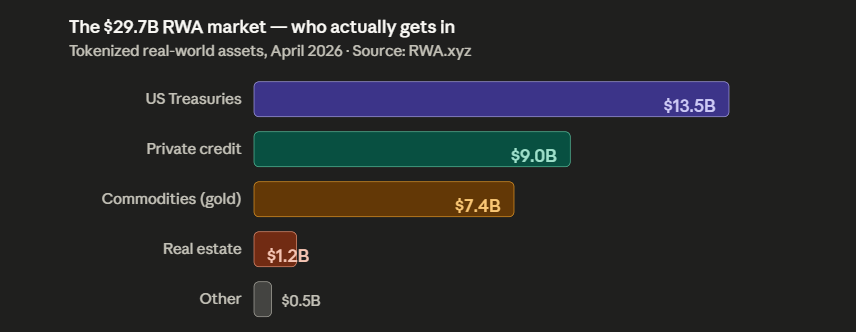
THE ACCESS LADDER NOBODY IS DRAWING
The top five tokenized Treasury products control 68.8% of the entire sector. BlackRock’s BUIDL sits at $2.4 billion managed through Securitize, targeting US Qualified Purchasers with a $5 million minimum entry. 99Bitcoins
That’s not a retail product. That’s a private club with better settlement rails.
And here’s the thing that minimum isn’t arbitrary malice. US securities law requires it. Qualified Purchaser status exists to “protect” retail investors from instruments regulators consider complex. The blockchain didn’t create that wall. But the narrative around blockchain ethos: anyone, anywhere, any amount pretends the wall isn’t there.
Circle’s USYC, which briefly overtook BUIDL, is domiciled in Bermuda, structured primarily for non-US investors. Spoted Crypto Bermuda isn’t a quirky location choice. It’s regulatory arbitrage staying outside the jurisdictions where retail protections would apply. The product that “won” the democratization race chose to live somewhere retail investors mostly can’t follow.
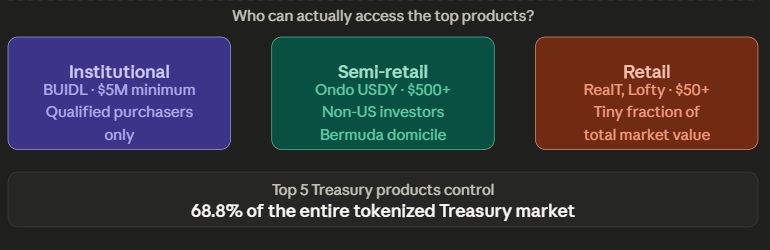
Meanwhile, tokenized real estate platforms like RealT start at $50 MetaMask genuinely accessible. But that segment is a rounding error in total market value. The $13.5 billion Treasury market, the institutional-grade products, the yield that actually beats inflation that’s where the capital lives. And it lives behind a velvet rope with a $5 million sign on it.
Every financial instrument that promised to open up:- mutual funds, ETFs, REITs eventually rebuilt its own access wall. The democratization was always partial, always conditional, always dependent on who set the rules. RWA tokenization is running the same play, just at blockchain speed. The ledger is public. The product is not.
The uncomfortable question for emerging markets where tokenized finance is most needed and most loudly promised is this: who does a $50 minimum entry actually serve, when the instruments generating real institutional yield require $5 million to touch?
129,000 agents. Zero legal answers.
Now here’s where the story gets stranger.
As of early 2026, over 129,000 AI agents are registered to manage complex on-chain transactions autonomously moving liquidity across protocols. We’ve built a system where software makes financial decisions without asking a human first. And we’ve done it before resolving a question that sounds almost embarrassingly basic:
When one of them loses money or worse, moves it somewhere it shouldn’t, who goes to court?
The legal question is wide open: is it the developer who wrote the code, or the owner who deployed the agent? Right now, the answer is effectively neither because the frameworks to decide haven’t been written yet. The agents are already deployed. The liability is theoretical. That gap is not small.
Two things happened in the last few weeks that tell you exactly how the industry is responding.
Nava, backed by Polychain and Archetype, raised $8.3 million to build an escrow layer that holds funds until an agent’s proposed transaction is verified against the user’s intent, then posts the reasoning on-chain so other AI agents can reference it. Fortune
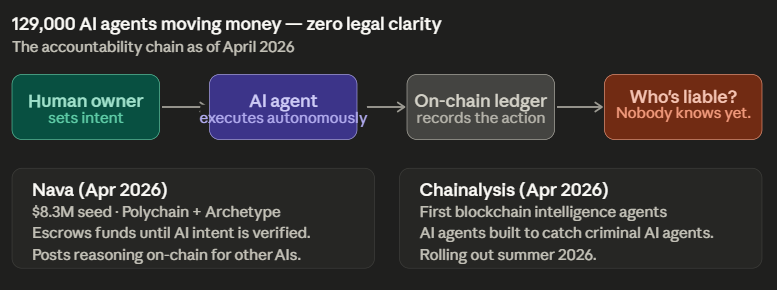
Read that again. The solution to AI accountability is: let other AIs read the first AI’s reasoning and decide if it was correct. That’s a public ledger of machine decisions which is either the most transparency finance has ever seen, or the first step toward AI agents citing each other as moral authority. Probably both.
Meanwhile, Chainalysis launched its first blockchain intelligence agents this month explicitly framed as a response to criminal actors already using AI to scale fraud, theft and money laundering.
So. We have AI agents moving assets. We have AI agents verifying other AI agents’ reasoning. We have AI agents policing AI agents for fraud. And somewhere in the middle of that chain, a human being is supposed to be accountable on a public ledger for what the software decided.
Blockchain was built because we stopped trusting humans to keep score honestly. AI agents are the next layer: systems that don’t need humans to keep score at all. The ledger was supposed to be the accountability layer. The uncomfortable mirror this week is asking whether it still is when the entities writing to it aren’t human.
What Really Matters
Strip everything back. Here’s what’s actually true:
The RWA market is real, the growth is institutional and the infrastructure is being built by the most conservative capital allocators in the world. That doesn’t change. But the story being sold blockchain is democratizing finance is running ahead of the structure that would actually make it true.
And AI agents are already embedded in that structure, moving capital, executing decisions, building reputation scores on-chain before the legal frameworks that would define their accountability exist.
The ledger has always been honest. It’s the humans writing the narrative around it that need watching.
© [Easy Weezy From EasyRococo📈] 2026
“If you find such topics interesting And enjoy reading my post, feel free to support my work by buying me coffee or upgrading to paid subscription thank you for your support, bye for now”
Scary stuff, I think in 10 years our world will look very different than it does today. Things are changing rapidly!