

REAL WORLD ASSET (RWA)
From Concept to Crypto Infrastructure

What Are RWAs?
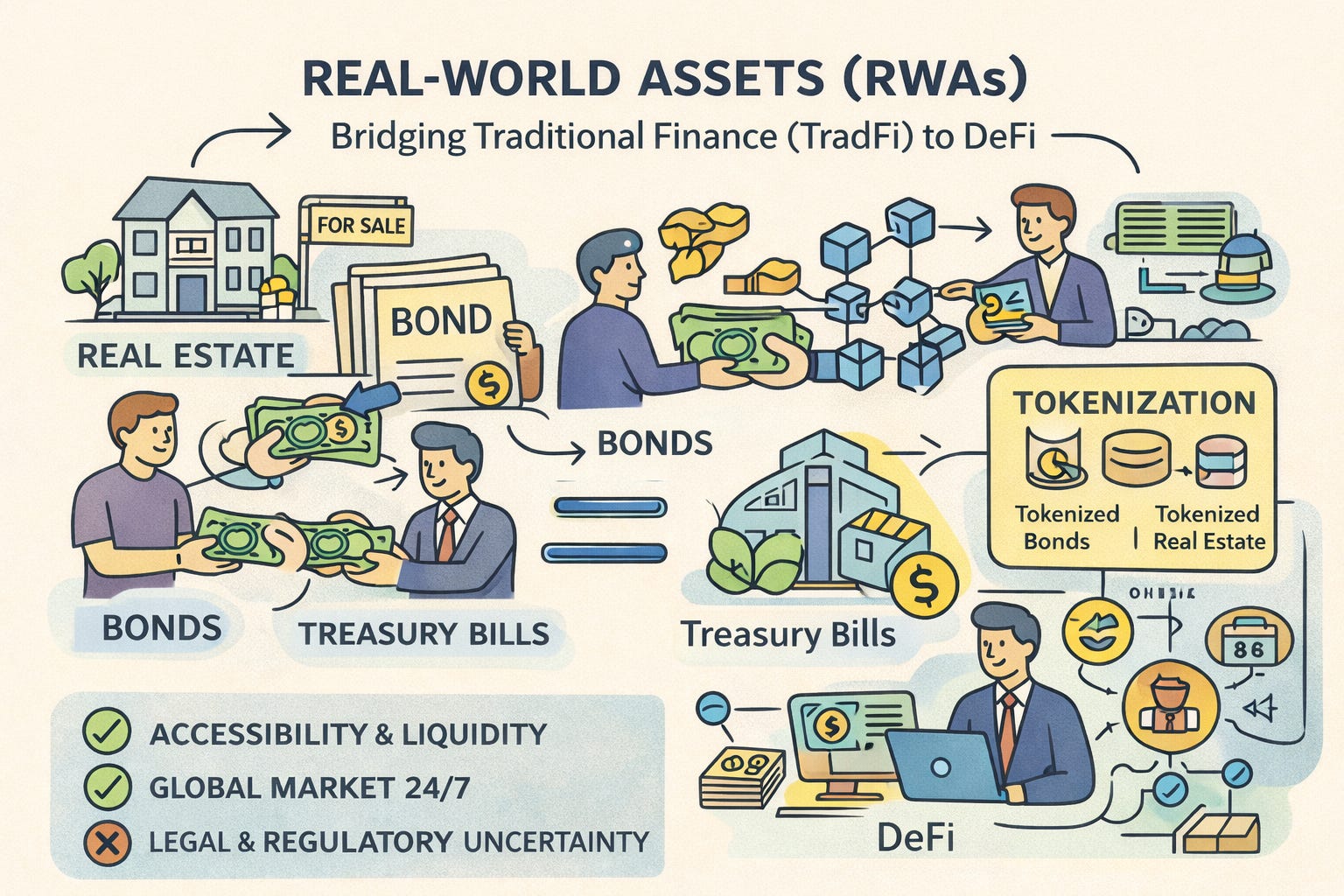
Real-World Assets (RWAs) are off-chain financial assets, such as real estate, bonds, private credit, commodities and other tangible or intangible instruments that are represented on a blockchain as digital tokens.
Instead of existing solely in traditional ledgers( Books e.g General Ledger, Sales Ledger, and Purchases Ledger) these economic rights and cash flows are encoded into smart contracts, making them tradable within decentralized finance (DeFi) ecosystems.
This tokenization brings real economic value on-chain (blockchain), bridging the traditional financial system (TradFi) and crypto-native finance (DeFi).
Key Components of RWAs
Real Estate
Tokenized real estate allows fractional ownership of properties, commercial, residential or income-producing buildings, Thus enabling global investors to access high-value illiquid markets previously reserved for institutions. Blockchain ensures transparent, immutable records of ownership and simplifies rental income distribution, making them liquid and tradable easily and at low cost.Mitosis University
Why it matters:
Reduces barriers to entry
Enables 24/7 trading of property shares
Investment becomes more accessible and liquid
Challenges:
Navigating varied legal ownership laws
Accurate valuation and appraisal methods
Bonds & Fixed-Income Instruments
Tokenized bonds, including government, corporate or structured notes can be issued in smaller denominations (fractionalized), traded around the clock and managed via smart contracts that automate interest payments(yields) and maturity/redemption.
An example.
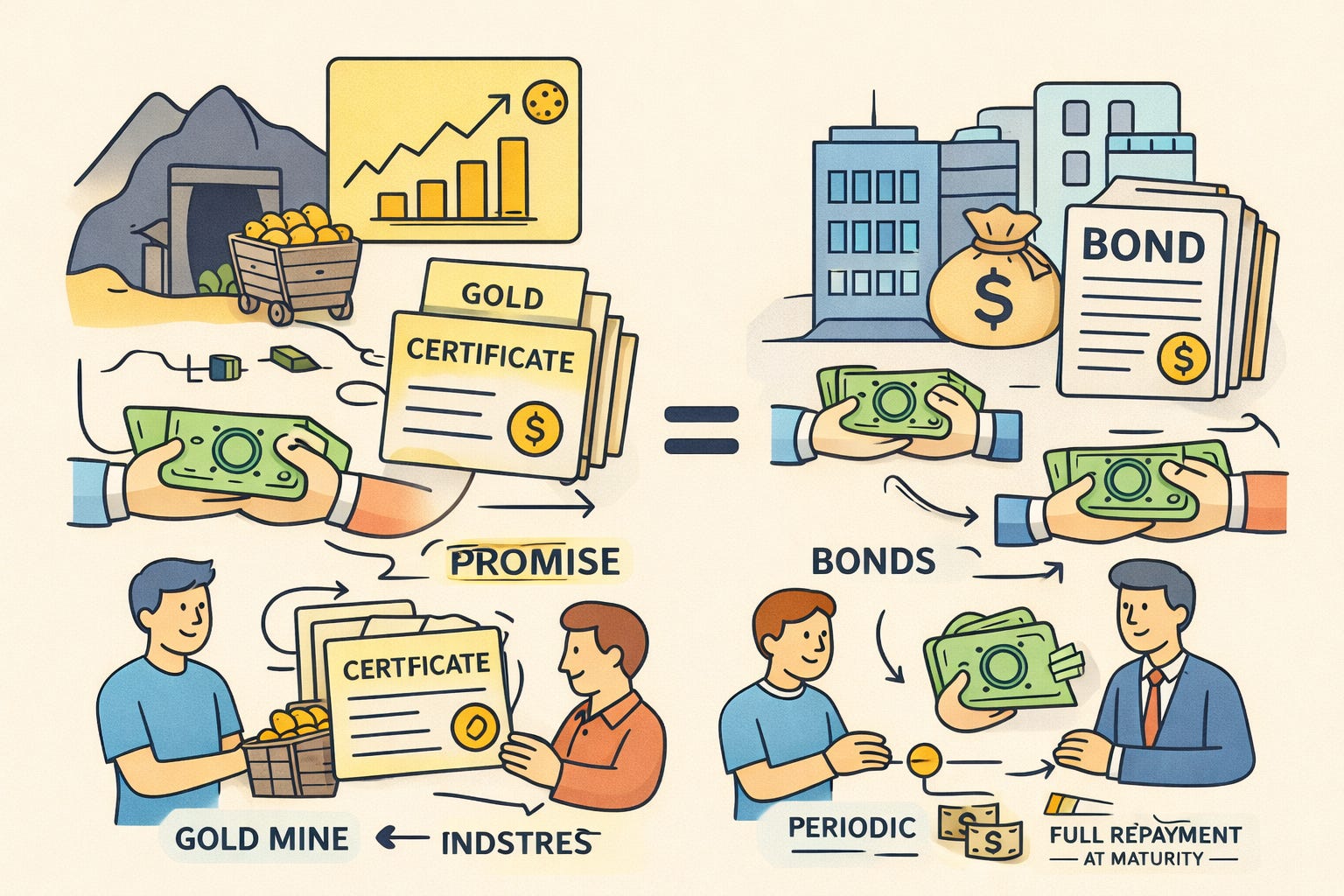
A mine owner sells certificates that represent future gold, even though the gold hasn’t been dug up yet. Buyers aren’t holding gold today, they’re holding a promise backed by real value that will be delivered later.
That is exactly how bonds work.
When a government or company issues a bond, they are essentially saying:
“Give us your money today.
We will use it to build, invest, or operate.
In return, we promise to pay you interest along the way
and give you your full money back at the end.”
You don’t buy the business.
You don’t run their operations.
You simply hold the promise.
Just like the gold certificate:
the value of the bond is tied to something real
the asset itself may be delivered or matured later
price changes in the market do not erase the obligation
If interest rates rise or markets swing wildly, the issuer still owes:
✔ your principal
✔ your interest payments
That’s why bonds are called fixed income, the outcome is defined from day one.
In simple terms:
Bond = an IOU where your money works for someone else,
and they pay you for the privilege of using it.
This is also why bonds are foundational to Real-World Assets (RWAs) on-chain. Tokenized bonds do the same thing but with added benefits:
faster settlement
transparent ownership records
programmable interest payments
global accessibility
24/7 markets
The promise stays the same, the rails just move to blockchain.
Just like those gold certificates represented future ounces,
tokenized bonds represent future cash flows.
And that is the bridge between TradFi and DeFi in action.
Why it matters:
Expands investor (retail and wholesale) access beyond institutional floors
Real-time settlement
Automation reduces administrative friction
Challenges:
Regulatory classification (e.g., securities laws)
Compliance across jurisdictions
Private Credit & Other Instruments
Private credit markets loans and debt to companies or individuals outside public markets, have historically lacked liquidity and transparency. Tokenization can improve access and openness, expanding this vast market to new participants. research.tren.finance
Why it matters:
Unlocks traditionally illiquid investment classes
Enables DeFi protocols to use tokenized credit as collateral
Challenges:
Complex legal and operational frameworks
Limited secondary trading volume
Why TradFi Needs RWA Tokenization
Bringing real assets on-chain answers critical inefficiencies in traditional financial markets:
Liquidity: Many TradFi assets, like real estate and private credit, have very limited liquidity. Blockchain tokens can be traded continuously, potentially increasing market depth.
Accessibility: Tokenization lowers minimum investment sizes and enables global participation without intermediaries. Cointelegraph
Transparency & Automation: Blockchain immutability and programmable contracts create auditable records and automated income streams (e.g., rental payments, bond coupons).
Cost Efficiency: Removing layers of intermediaries can reduce fees and settlement times.
What This Signals for TradFi ↔ DeFi
RWA tokenization signals a fundamental shift in global finance from siloed, slow, and opaque systems toward composable, global, 24/7 markets. Rather than replacing TradFi, DeFi becomes an augmentation layer: TradFi assets remain legally anchored, but benefit from the transparency, accessibility, and efficiency of blockchain infrastructure.
This trend is already attracting large institutions and regulators to experiment with tokenized products including traditional banks issuing structured notes on-chain with full legal validity.
Advantages of RWA Tokenization
Fractional Ownership: Investors can own small slices of high-value assets.
Global Market Access: Investors can access assets across borders without intermediaries.
24/7 Liquidity: Markets can operate continuously, unlike traditional trading hours.
Automated Compliance & Cash Flows: Smart contracts can handle dividends, rent, or interest payments.
Risks & Challenges
Despite promise, tokenized RWAs bring new complexities:
Legal & Regulatory Uncertainty
Different jurisdictions apply varied securities and property laws to tokenized assets creating classification ambiguity and compliance hurdles.
Counterparty & Custody Risk
To enforce off-chain legal rights, RWA systems often rely on custodians, trustees, or SPVs reintroducing trust into systems that aim to reduce it. TLP Advisors
Liquidity Constraints
Tokenization creates liquidity potential but doesn’t guarantee it; many RWA markets still have thin trading volumes and are difficult to exit swiftly.
Technical & Oracle Risks
Accurate off-chain data is critical if oracles fail or are manipulated, token value and execution may be compromised.
© [Easy Weezy] 2025 |A Curious Mind
“If you find such topics interesting And enjoy reading my post, feel free to support my work by buying me coffee or upgrading to paid subscription thank you for your support, bye for now”
Water damage restoration in san diego CA
https://in.pinterest.com/home2homepro/_profile/
Hey